

Deploy reliable AI agents at scale
Nebius gives you the open platform, sustained inference, and a validated blueprint to build any kind of coding, service, or workflow AI agent — and take it to production without lock-in, capacity constraints, or unpredictable costs.
Why run AI agents on Nebius
Sustained throughput for always-on agents
Token Factory delivers predictable latency under sustained load with dedicated endpoints and autoscaling.
Open architecture, no lock-in
Choose and replace components across models, providers, and infrastructure while maintaining full control over your AI stack.
Reserved GPU capacity with full visibility
Capacity Blocks + real time Dashboard. Your agents never stall waiting for GPUs.
Built for continuous improvement
Monitor, evaluate, simulate, and optimize agent performance over time with observability and evaluation built into the architecture.
Enterprise-ready security and compliance
Deploy agents with built in network isolation, identity management, audit logging, and certifications your customers already require.
Every capability agents need. An open platform you fully own
Nebius provides the inference, tools, and infrastructure for production agents. Every component is open and replaceable — bring your own models, frameworks, and integrations alongside.
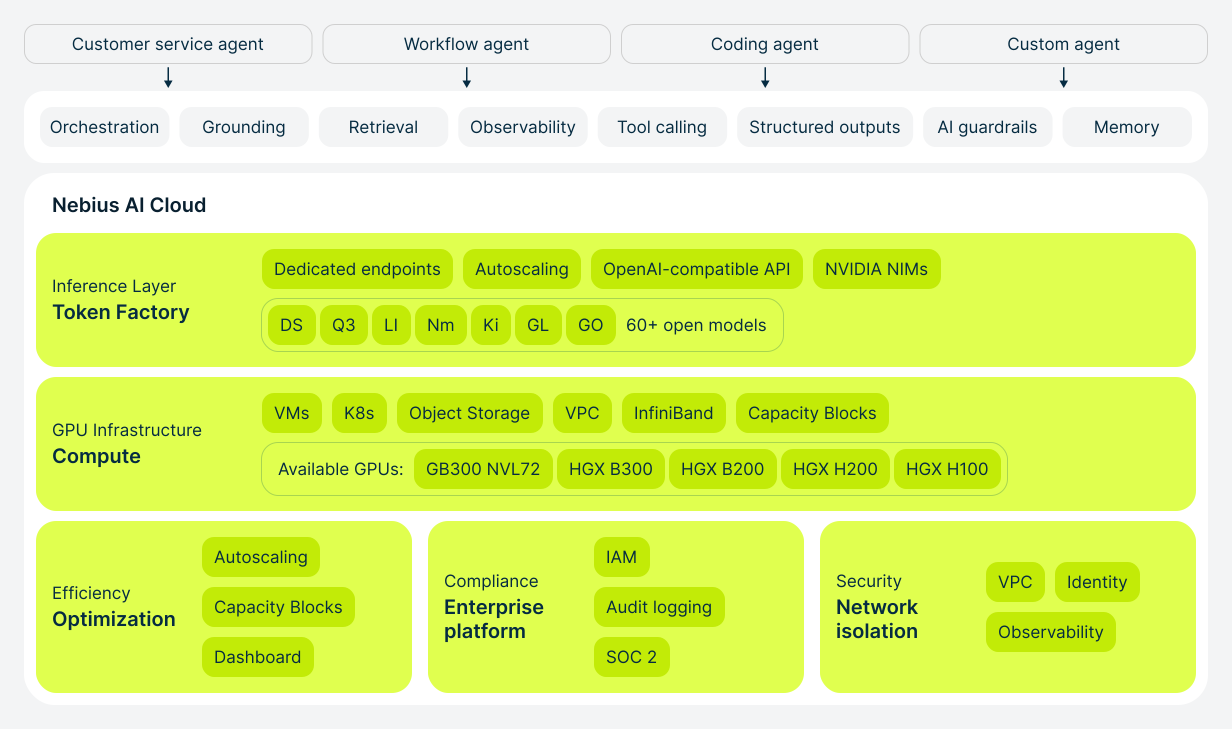
Nebius Agents Blueprint
A production-ready starting point for AI agents.
Orchestration and observability
Multi-step agent workflows with end-to-end visibility into prompts, tool calls, retrieval, and actions.
Knowledge retrieval
Governed, cited, task-specific knowledge that improves accuracy and reduces token consumption.
Live grounding
Real-time web search with source reliability filtering. Keep agent responses current and grounded.
Simulation
Test agents against realistic scenarios before launch. Generate regression suites to continuously improve quality.
From prototype to production
We built a regulatory compliance audit agent first as a GPT 5.5 prototype, then progressively rebuilt it on open models using Blueprint components: structured retrieval, live grounding, observability, and simulation.
The open-model production version outperformed the prototype across every metric. The biggest gains in precision, cost, and execution time came from better architecture — not from switching to a better model. Read the blog post.